

If you’ve ever typed “what’s that board game that’s called Clue something” into Google, you’re not alone. People half-remember this game all the time — Colonel Mustard, a candlestick, someone shouting “it was in the library!” But the exact name, the rules, and where to buy it tend to get fuzzy. Let’s clear it up.
So What’s the Game Actually Called?
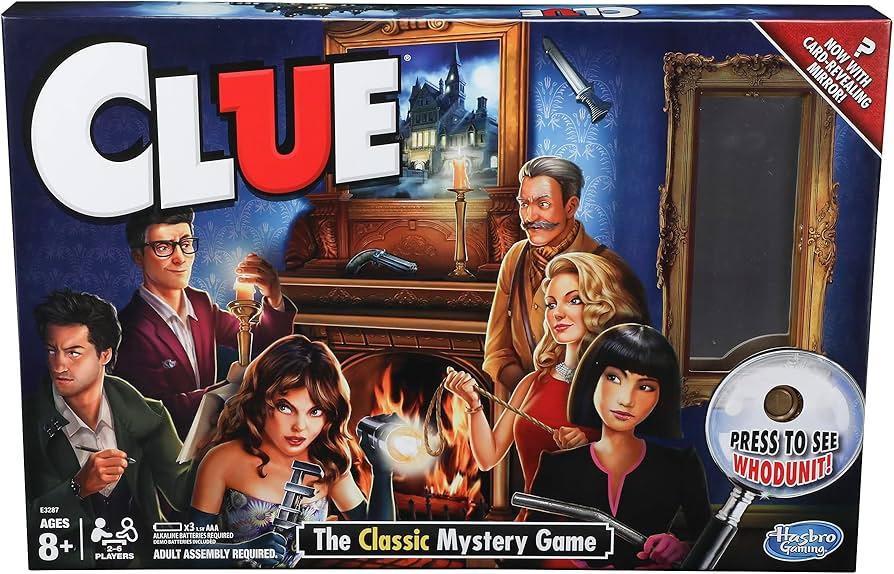
The game is Clue in the US and Canada. Everywhere else — the UK, Australia, most of Europe — it’s called Cluedo. Same game, two names.
Here’s why: it launched in Britain in 1949 as “Cluedo,” a blend of “clue” and “ludo” (Latin for “I play”). When it crossed the Atlantic, Parker Brothers shortened it to “Clue” for American shelves. The name just stuck.
So if you’ve been picturing “that murder mystery board game” or “the one with the wrench and the candlestick,” this is it.
What Is Clue/Cluedo About?
Clue is a murder mystery game for 3–6 players. Someone — Mr. Boddy — has been killed in his own mansion. Players take on the role of detective and try to solve three things:
- Who did it (six suspects, including Colonel Mustard and Miss Scarlet)
- Where it happened (nine rooms, like the Library or the Conservatory)
- What weapon was used (six weapons, including the candlestick, rope, and revolver)
You move around the board, ask questions, and rule out suspects through logic. Eventually, you make your final accusation. It’s part board game, part puzzle, and it’s stayed popular for over 70 years because of that mix.
(Want a full rules breakdown next? I can add a “How to Play” section.)
Why People Forget the Name
A few things make this game easy to forget:
- Two names. Clue in the US, Cluedo almost everywhere else. That alone creates confusion.
- It’s old. The game dates back to 1949, so many people only remember playing it as kids, decades ago.
- Spin-offs everywhere. Movies, TV specials, themed editions — they all borrow the “vibe” without always using the name clearly.
- It sounds generic. “Play Clue” almost sounds like a typo rather than a real title, which throws people off.
Popular Versions of Clue You Can Buy
Once people remember the name, the next question is usually: which version should I buy? Here are the most popular options, depending on your group and budget.
Classic Clue (Original Edition)

The version most people grew up with. Mr. Boddy’s mansion, six suspects, six weapons, nine rooms.
👉 [ Amazon link ]
Clue Grab and Go (Travel Edition)

Small and portable. Great for road trips, flights, or tight spaces.
👉 [ Amazon link ]
Clue: Harry Potter Edition

Same core gameplay, set in the wizarding world. A solid pick for Potter fans.
👉 [ Amazon link ]
Clue Junior

A simplified version for younger kids, ages 5 and up. Instead of a murder, kids solve a missing-cupcake mystery.
👉 [ Amazon link ]
Clue: The Card Game

A faster, card-based spin-off built around the same deduction concept.
👉 [ Amazon link ]
Cluedo (UK/International Edition)

If you’re outside the US, this version keeps the original British branding and room names.
👉 [ Amazon link ]
Where to Buy Clue/Cluedo
Amazon usually has the widest selection — classic, themed, and travel editions — plus fast shipping and easy returns. You’ll find direct links to each version above.
Frequently Asked Questions
Is Clue the same as Cluedo?
Yes. It’s the same game with a different name depending on the country. North America uses “Clue.” The UK, Australia, and most other countries use “Cluedo.”
How many players do you need for Clue?
You need at least 3 players. The standard board supports up to 6.
What age is Clue appropriate for?
The classic version works well for ages 8 and up. For younger kids, try Clue Junior instead, which is rated for ages 5+.
Is there a movie based on Clue?
Yes. A 1985 film called Clue became a cult classic, mostly known for its multiple alternate endings.
Related Articles: