


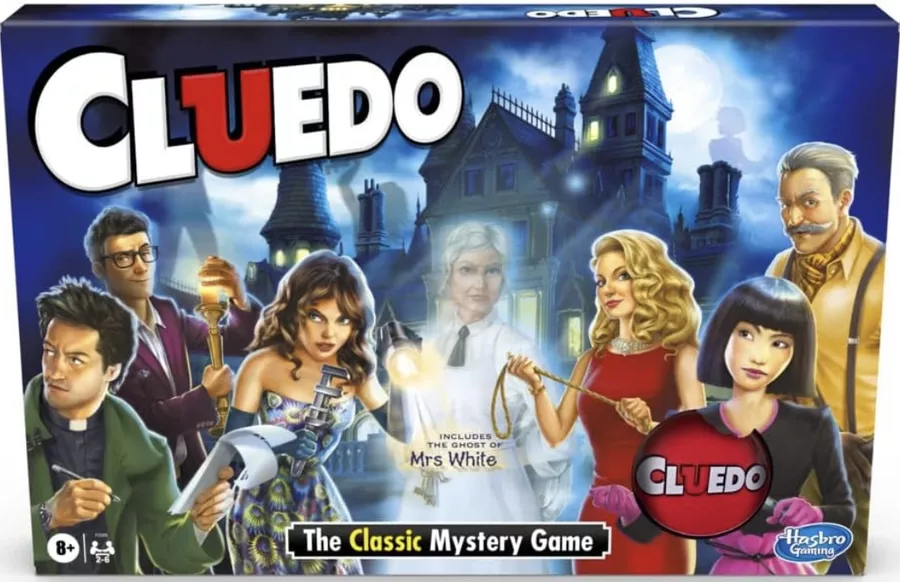


Clue Board Game – Amazon Exclusive Edition
Check out this clue board game review if you’re looking for one of the most iconic mystery games ever created. The clue board game has been around since 1949, and I’ve been playing it since I was eight years old at my grandmother’s house. There’s something addictive about accusing Colonel Mustard of murder with a candlestick—even after you’ve played a hundred times.
Whether you call it Clue or Cluedo (the British version), this game deserves its spot in the board game hall of fame. I grew up scribbling notes on those tiny detective pads, and honestly? I still get excited when I narrow down the solution before anyone else. If you enjoy detective stories and puzzle-solving, check out our guide to other mystery board games.


Why the Clue Board Game Still Holds Up


The clue board game works because it’s dead simple to learn but surprisingly tricky to master. Someone killed Mr. Boddy (or Dr. Black if you’re playing the UK version) in his mansion. Your job? Figure out who did it, what weapon they used, and which room it happened in.
Here’s what makes it interesting: there are six suspects, six weapons, and nine rooms. That’s 324 possible combinations. Every single game plays differently. You can’t memorize solutions like some games where optimal strategies get boring after a few plays.
But the real genius of the clue board game isn’t just deduction—it’s psychology. You’re watching what other players ask about, tracking what they can’t disprove, and sometimes bluffing with your own cards. That human element keeps things fresh even after decades.
How This Game Got Started

Anthony Pratt invented the clue board game during World War II while stuck in Birmingham, England during air raids. Picture this: it’s 1943, bombs are falling, everyone’s hiding indoors during blackouts. Pratt was a musician who’d played at fancy hotels where guests ran murder mystery parties. So he started designing his own murder mystery game on paper to pass the time.
His wife Elva helped him build the board on their dining room table. He originally called it “Murder!” which honestly might’ve been too on-the-nose. They patented it in 1944, but because of post-war shortages, it didn’t actually hit stores until 1949.
Waddingtons bought the UK rights and renamed it “Cluedo”—mixing “clue” with “ludo” (Latin for “I play”). Parker Brothers grabbed the North American rights and shortened it to just “Clue” because Americans weren’t familiar with Ludo-style games.
Fun fact: Pratt’s original design had 10 characters and weapons like a shillelagh and hypodermic syringe. The publishers wisely cut it down to six of each. Learn more about the game’s origins at the Joseph Schneider Haus Museum, which houses historical gaming artifacts.
How to Actually Play the Clue Board Game


The mechanics are simple but I’ll walk you through it.
Setup: Three cards get sealed in a confidential envelope—one suspect, one weapon, one room. That’s your solution. The rest of the cards get dealt to players. Everyone gets a detective notepad to track clues.

Your Turn: Roll dice, move your token through the hallways. Once you reach a room, you make a “suggestion” about the murder. Let’s say you’re in the Library. You might say: “I think it was Miss Scarlet, in the Library, with the Revolver.” You move Miss Scarlet’s token and the Revolver into that room with you.
Disproving: Starting with the player to your left, everyone tries to disprove your suggestion. If someone has one of those three cards, they secretly show you one (just one, their choice). That proves that card isn’t in the solution envelope.
Accusation: Once you’re confident, you can make a final accusation. But be careful—if you check the envelope and you’re wrong, you’re out. You can still disprove other players’ suggestions, but you can’t win.
Winning: First person to correctly identify all three elements wins.
Strategies That Actually Work


I’ve played this game way too many times. Here’s what separates winners from losers:
Take notes on everything. This sounds obvious but most casual players don’t do it properly. Don’t just mark off your own cards. Track every single thing that gets revealed. When Player 3 shows Player 1 a card during a suggestion about the Ballroom, mark that down. You might not know which specific card they showed, but you know Player 3 has at least one of those three cards.
Suggest every single turn. Any turn you don’t make a suggestion is wasted. Even if you already know certain facts, keep asking questions to learn about the remaining unknowns.

Use your own cards as bait. This is a clever trick most beginners miss. Let’s say you have the Rope card. You can suggest scenarios involving the Rope because you know nobody will be able to show it to you. If you suggest “Professor Plum with the Rope in the Kitchen,” and nobody disproves it, you’ve just learned that either Professor Plum or the Kitchen (or both) are in the envelope.
Secret passages are overpowered. Certain rooms connect through secret passages that let you move without rolling. Use these to make suggestions in two different rooms on back-to-back turns while everyone else gets stuck rolling poorly.
Watch what people keep asking about. If three different players all suggest the Wrench and nobody can disprove it, the Wrench is probably in the envelope. Everyone’s testing the same theory.
Be strategic about which card you show. When you have to disprove someone and you’ve got multiple cards that work, always show them the same one repeatedly. Why give away extra information?
Start broad, then narrow. Early game, test multiple unknowns at once. Late game, make targeted suggestions to confirm your final theory.
Different Versions of the Clue Board Game


The clue board game has changed a lot since 1949, though the core gameplay stays the same.
Character Updates: In 2008, Hasbro modernized everyone. Colonel Mustard became Jack Mustard the soccer star. Professor Plum became Victor Plum, a billionaire video game designer. Then in 2016, they replaced Mrs. White with Dr. Orchid, a scientist—the first new character in decades.
Themed Editions: You can get Star Wars Clue, Simpsons Clue, Scooby-Doo Clue, Alfred Hitchcock Clue… the list goes on. They all keep the same deduction mechanics but reskin everything.

Clue Junior: For younger kids (age 5+), there’s a simplified version where instead of murder, you’re figuring out who ate the last cookie or broke a toy. Less dark, same concept.
Our Top Pick – Clue Game Board – Amazon Exclusive Edition
Clue Board Game – Amazon Exclusive Edition
- Classic gameplay with updated artwork
- 3-6 players, ages 8+
- Includes game board, 6 suspect tokens, 6 weapons, deck of clue cards, detective notepad, dice
- ⭐⭐⭐⭐⭐ Highly rated Amazon exclusive version
- Perfect for family game nights
This Amazon Exclusive edition is the one I’d recommend for most families. It’s got the classic Clue gameplay everyone knows with quality components at a reasonable price point.
Who Should Buy the Clue Board Game?
Pretty much everyone aged 8 and up will get something out of it.
Families: The clue board game is a family game night staple for good reason. Eight-year-olds can understand it, but adults don’t feel like they’re dumbing down. Games run about 45-60 minutes, which is perfect—long enough to feel substantial but short enough that nobody gets bored. Looking for more family-friendly options? Read our article on best board games for families.
Casual gamers: You don’t need to be a board game nerd to enjoy this. I can teach the rules in ten minutes flat. But it’s strategic enough that you’ll want to play again.
Mystery fans: If you’re into true crime podcasts, detective novels, or whodunit movies, the clue board game scratches that same itch. It captures the satisfaction of piecing clues together.
Strategy players: Don’t let the mainstream popularity fool you. Good players track probabilities, make calculated bluffs, and use advanced deduction. There’s real depth here.
Player count sweet spot: The box says 3-6 players. With three, everyone holds too many cards and it’s too easy. With six, turns drag. Four or five players is ideal.
Clue Board Game Compared to Other Mystery Games


How does the clue board game stack up?
Mysterium: Way more visual and cooperative. The clue board game is competitive and logic-based.
Sherlock Holmes Consulting Detective: Much heavier with full narrative stories. The clue board game is streamlined and focuses on pure deduction.
Deception: Murder in Hong Kong: Adds social deduction with hidden roles. The clue board game is more straightforward—all information eventually becomes available through process of elimination.
13 Dead End Drive: Similar mansion-murder theme but with player-vs-player traps and chaos. The clue board game is more cerebral.
The clue board game nails the balance. Complex enough that skill matters, simple enough that your mom can beat you. For another classic tabletop experience, see our complete chess strategy guide.
Mistakes New Players Always Make

I’ve taught this game to dozens of people. Here are the mistakes I see constantly:
Sloppy note-taking. People mark off their own cards but don’t track what others reveal. You need to record everything—every card shown, which player showed it, everything.
Guessing too early. The second you think you know, there’s this huge temptation to make your accusation. But one wrong guess eliminates you. Wait until you’re 100% certain.
Wasting movement. Plan your path efficiently. Get to rooms with secret passages. Position yourself to maximize suggestions.
Showing different cards to the same person. If you have to disprove someone and you’ve got multiple cards that work, always show the same one. Varying which card you show gives away free intel.
Ignoring other players’ questions. Pay attention to what everyone’s testing. If multiple people suggest the Wrench and nobody disproves it, that tells you something important.
Forgetting secret passages exist. Use them! They’re ridiculously powerful for rapid-fire suggestions.
The Clue Board Game’s Cultural Impact
The clue board game has seeped into popular culture more than most board games.
There’s the 1985 movie with Tim Curry that’s become a cult classic. They shot three different endings and sent them to different theaters, which was wild. There have been musicals, TV shows, video games, and countless references in other media.
“Colonel Mustard in the library with the candlestick” has become shorthand for mystery-solving in general. People who’ve never played the game still know that reference.
Online forums like BoardGameGeek have thousands of posts about advanced strategy, probability math, and custom variants. There’s a whole competitive community that takes this seriously. Learn more about competitive Clue tournaments and strategy from the World Boardgaming Championships.
My Honest Take After Years of Playing
Look, the clue board game isn’t breaking new ground. It’s not the most innovative or complex game on my shelf. But that’s not the point.
It does one specific thing exceptionally well: accessible mystery-solving. It captures detective work—gathering info, eliminating possibilities, making logical leaps—without requiring a PhD or three hours to learn.
Yeah, luck matters. Sometimes you get dealt half the solution and cruise to victory. Other times you’re stuck guessing blindly while someone else gets all the breaks. But over multiple games, skilled players consistently win more often.
The game’s been around for 75 years for a reason. It works for kids, adults, grandparents, gamers, non-gamers—basically everyone. New to board gaming? Start with our beginner’s guide to board games.
Fair warning: once you introduce the clue board game to your group, it becomes a regular request. The combination of nostalgia, strategy, and those satisfying “aha!” moments when you figure out the solution keeps people coming back.
Whether it’s your first murder mystery or your thousandth, the clue board game still delivers that same thrill.
Quick Reference:
- Players: 3-6 (sweet spot is 4-5)
- Time: 45-60 minutes
- Age: 8+
- Designer: Anthony E. Pratt
- Original Publisher: Waddingtons (UK), Parker Brothers (US)
- Current Publisher: Hasbro
- First Released: 1949
- Price Range: $15-30 for standard editions